

Open-Source Investigative Reporting
Applications open for Spring 2026 and Fall 2026
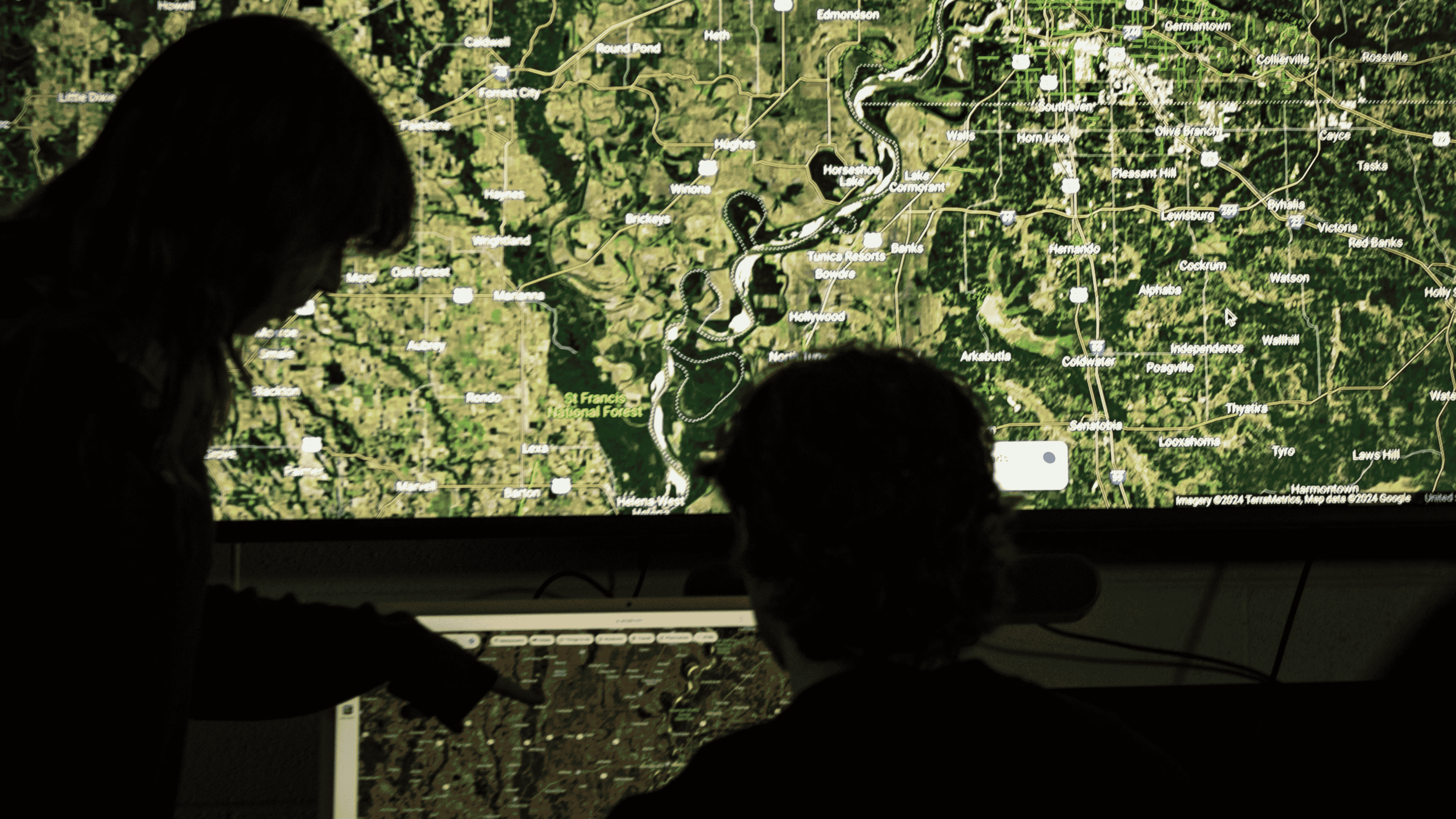
In a world replete with tons of digital evidence, open-source investigations have become one of the most powerful tools of modern journalism.
The M.A. in Open-Source Investigative Reporting at the University of Memphis is designed to train the next generation of investigative journalists, researchers and media professionals.
In this one-of-a-kind Master’s program, students will learn to combine traditional methods of investigative reporting with the use of new-age, open-source intelligence (OSINT) tools, advanced data sourcing and analysis, computation pipelines and artificial intelligence.
All in the pursuit of finding and telling important stories.
Jump to:
- What Students Will Learn
- Core Benefits of the Program
- Scholarships and Financial Aid
- Program Timeline
- Application Deadlines
- Program Overview
- Frequently Asked Questions
- How to Apply
Want to learn more? Email Prof Meghnad Bose, coordinator of the Open-Source Investigative Reporting program at the University of Memphis. Or schedule a one-on-one info session here.
What Students Will Learn
The program will train you to:
- Analyze digital information captured from social media, through satellite imagery, in public records, from your
own reporting and a variety of other sources.
- Learn OSINT skills such as geolocation (finding where an image or video was taken), chronolocation (figuring out when it was taken), image and video verification, and more.
- Source, process and analyze large datasets, with the aid of computation and automation when necessary or convenient.
- Use artificial intelligence in a manner that is journalistically accurate, responsible and ethical.
- Launch and lead open-source and visual investigations from start to finish.
Core Benefits of the Program
- Practical training, with principles: The program will integrate hands-on training with an understanding of ethics and accountability regarding the use of open-source intelligence and information in journalism.
- Publishing opportunities: Students will work on open-source investigative projects in collaboration with the
Institute for Public Service Reporting, an award-winning investigative newsroom based out of the University of Memphis.
Students will have the opportunity to publish their work and showcase their open-source skills while pursuing the program.
- Industry-ready: Students will graduate with the skills that newsrooms are increasingly on the lookout for. They will gain the ability to participate in and even lead investigations and projects
that rely heavily on open-source information.
- Multidisciplinary applications: Beyond journalism, the skills taught in this program are widely applicable in the fields of human rights, advocacy and various kinds of research, including academic and legal.
Scholarships and Financial Aid
Incoming students will be eligible for scholarships and paid graduate assistantships from the Journalism and Strategic Media department to aid them in pursuing the program. No additional application is required to be eligible for the departmental scholarships or assistantships.
Program Timeline
This program is offered in residence on our Memphis campus, as well as remotely online. Students doing the program online will be joining the classes live on Microsoft Teams.
- Full-time students starting in the Spring semester can begin the program in January and complete it in December.
- Full-time students starting in the Fall semester can begin the program in August and complete it the following August.
- Part-time students can complete the same program over a higher number of semesters.
Application Deadlines
Deadline to apply for program beginning Spring 2026: November 15, 2025
Deadline for apply for program beginning Fall 2026: June 1, 2025
Program Overview and Course Requirements
Students in the Open-Source Investigative Reporting program will take the following courses:
JOUR 6183 - Open-Source Investigative Reporting I | Credit Hours: 3
JRSM 7122 - Open-Source Investigative Reporting II | Credit Hours: 3
JRSM 7124 - Data Journalism | Credit Hours: 3
JOUR 6180 - Public Issues Writing/Reporting | Credit Hours: 3
JRSM 7350 - Multimedia Reporting | Credit Hours: 3
JRSM 6700 - Media Law | Credit Hours: 3
JRSM 7600 - Graduate Media Practicum/Graduate Media Project | Credit Hours: 6
JRSM 7002 - Pro Seminar | Credit Hours: 3
(Core for all MA Journalism and Strategic Media students)
JRSM 7050 - Mass Comm Theory | Credit Hours: 3
(Core for all MA Journalism and Strategic Media students)
Frequently Asked Questions
- Do I need to have prior journalism experience to be part of this program?
No — our students will be from a variety of educational and professional backgrounds. The skills taught in this program are useful and applicable in a variety of professions, including but not limited to journalism, human rights, research, and advocacy. Applicants, therefore, do not need to have any prior journalism experience in order to be considered for this program.
- Do I need to have prior technical experience with open-source tools to be part of this program?
No — we will teach each of the tools and techniques required for the program from
scratch. Prior technical experience with open-source tools is not required.
- Will this program be suitable for mid-career or experienced journalists?
Yes — as you know, the set of skills used in journalism is expanding, and this program will equip mid-career or experienced journalists with the knowledge and hands-on experience of using the new tools and techniques which are redefining modern investigative journalism.