

Spring 2026
PHIL 1101 - Introduction to Philosophy (multiple sections; online sections available)
Course Description
Introduction to critical exploration of such issues as knowledge, reality, consciousness
and the good life; readings from Plato, Descartes, Kant, Nietzsche, or more recent
sources.
PHIL 1102 - Introduction to Ethics (multiple sections; online courses available)
Course Description
Introduction to such social and ethical questions as, “What makes a happy life? What
justifies ideas of good and evil? How should we live with others? What is the role
of gender and race in society?” The subjects of justice, racism, and oppression, especially
as they figure into the American context, are highlighted.
PHIL 1611 - Elementary Logic (multiple sections; online courses available)
Course Description
Argumentation and debate is an important part of our lives. We might present an argument
for a raise to a boss or argue in the papers we write. We debate in the classroom,
the courthouse, or the halls of congress. While sometimes the goal of arguing is winning,
arguing is best when it helps us get closer to the truth. But arguing well is not easy and many people do not realize that there is a logic to it. This course
is a study of elementary methods of that logic. Through the examination of logical
concepts and the structure of sentences, this course will teach us how to make inferences
and reach conclusions in a way that avoids mistakes. This course will also investigate
common logical fallacies, so we can avoid making them and defend ourselves against
such fallacies. This course will focus on both formal and informal methods of logic.
Required Textbook (M50 online versions; always consult your syllabus or instructor
before purchasing textbooks)
MindTapV2.0 for Hurley/Watson's A Concise Introduction Logic, 1 term Printed Access Card. 2019. ISBN: 9780357419410
PHIL 2000 - Artificial Intelligence and its Ethics
CRN 30896
TR
9:40 - 11:05am
David Gray & Kevin Taylor
Course Description
While Artificial Intelligence (AI) began in the 1950s, recent work in Generative AI
has taken the world by storm, creating the possibility for both great advancement
and great harm. This course serves both as an Introduction to Artificial Intelligence
(and its roots in philosophy) as well as Ethical issues AI presents. This course will
give students a working knowledge of the different kinds of AI and what they can do,
the relationship between natural and artificial intelligence, and the ethical issues
in using AI that any user or producer of the technology should know (whether you are
just trying to keep yourself safe, avoid being fooled, or are interested in reducing
a company’s risk associated with AI).
This course is an elective for the AI for All Minor.
PHIL 3002 - History of Modern Philosophy
CRN
TR
9:40 - 11:05am
Dustin Taylor
Course Description
This course will focus on some of the major problems and traditions of inquiry from
the 17th and 18th centuries; one of the most revolutionary and fruitful periods in
the history of western philosophy. Special attention will be given to the questions:
“What is fundamentally real?” “What can we really know for certain?” “What is a ‘Self?”
and “What is freedom?” We will confront these questions by reading the work of canonical
figures such as Descartes, Leibniz, Locke, and Hume. In doing so, we will see the
tension between the “Rationalist” and “Empiricist” approaches to philosophy, which
is ostensibly resolved by the “critical” philosophy of Immanuel Kant.
PREREQUISITE
PHIL 1101 or PHIL 1102, or permission of instructor.
PHIL 3411-M50 - Contemporary Moral Problems
CRN 82005
Online/Asynchronous
Alejandro Toledo
Course Description
Such important contemporary moral issues as pornography and obscenity, capital punishment,
abortion, human rights, "reverse discrimination," and civil disobedience; underlying
philosophical ideas for each issue considered and discussed.
PHIL 3452 - Feminist Theory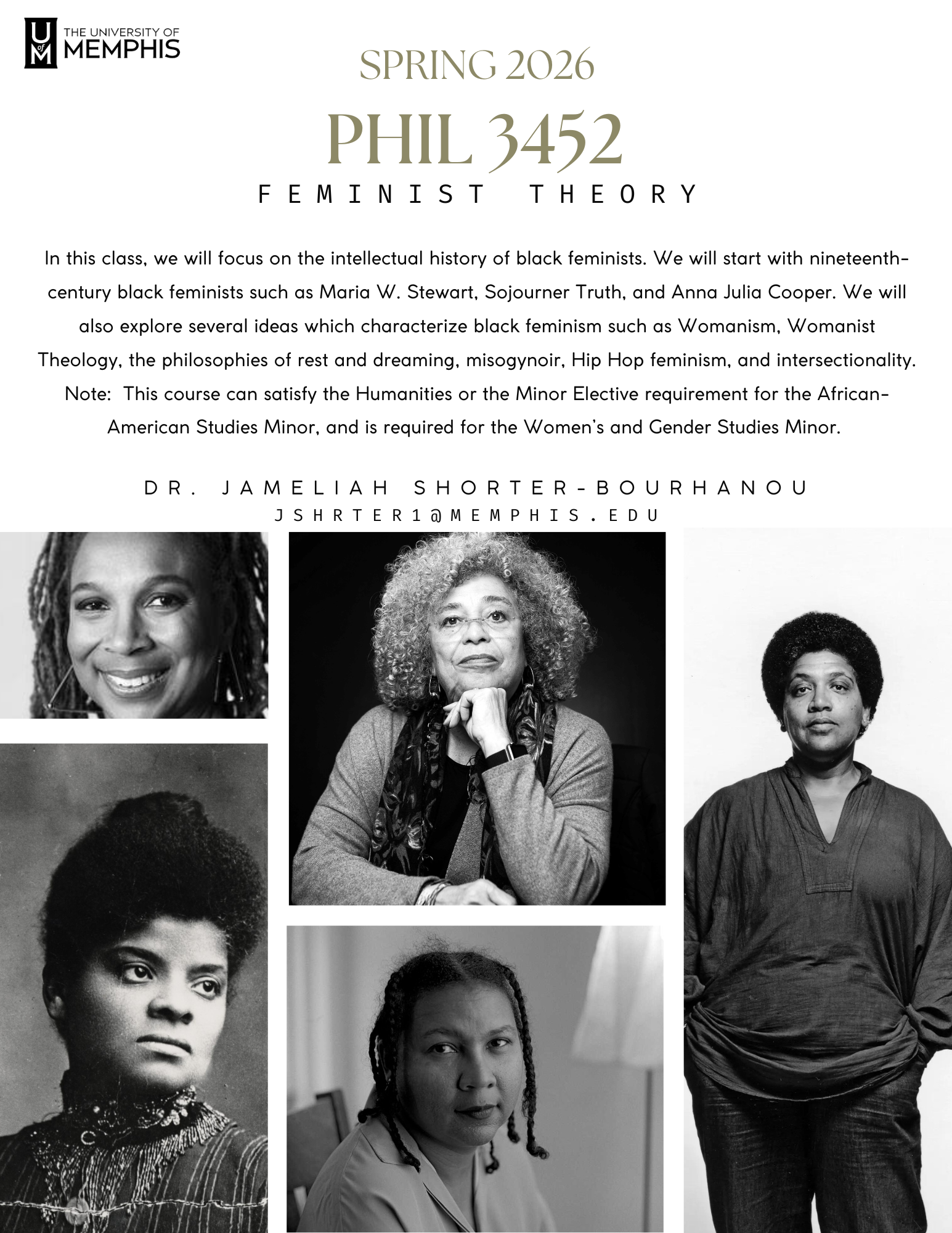
CRN 12091
MW
2:20 - 3:45pm
Jameliah Shorter-Bourhanou
Course Description
In this class, we will focus on the intellectual history of black feminists. We will
start with nineteenth century black feminists such as Maria W. Stewart, Sojourner
Truth, and Anna Julia Cooper. We will also explore several ideas which characterize
black feminism such as Womanism, Womanist Theology, the philosophies of rest and dreaming,
misogynoir, Hip Hop feminism, and intersectionality.
Note: This course can satisfy the Humanities or the Minor Elective requirement for the African American Studies Minor, and is required for the Women's and Gender Studies Minor.
PHIL 3460 - Nature/Mind/Knowledge
CRN 17812
TR
11:20 - 12:45pm
David Gray
Course Description
This course explores the nature of our knowledge, or minds, and how we relate to the
world. We will discuss what it is to have knowledge and have justification for our
beliefs, the nature of mental states such as consciousness, belief, desire, and memory,
our use of language and its dependency on the world, and how our minds might not be
completely located in our heads.
PHIL 3511 - Ethical Theory
CRN
MW
12:40 - 2:05pm
Remy Debes
Course Description
This course will take a deep dive into ethics, with special attention to the philosophical
grounding of major moral theories by Hume, Kant, and perhaps Mill. But the course
will also range more abstractly into what is known as “metaethics.” Here we will not
ask only “What should we value?” but also “What is value?” Likewise, instead of asking only “What are our obligations?” we will ask “What is obligation itself?” This part of the course will involve asking whether there are
any moral truths at all.
PHIL 3514 - Biomedical Ethics (multiple sections; online courses available)
Course Description
Discussion of ethical problems raised by contemporary medical practices and biological
innovations from standpoint of contemporary ethical theories including abortion, euthanasia,
human experimentation and genetic engineering.
Course Description (M50 online versions)
In this course we will begin by learning about moral theory, logic/argumentation,
and concepts related to biomedical ethics such as autonomy, paternalism, informed
consent, and more. We will then explore case studies in the modules that follow. Such
topics include human research, pandemic ethics, abortion, euthanasia, and health care.
You will be expected to apply moral theory to cases studies as well as identify relevant
concepts.
Required Textbooks (M50 online versions; always consult your syllabus or instructor
before purchasing textbooks)
Bioethics: Principles, Issues, and Cases by Lewis Vaughn (multiple editions available)
PHIL 3515-M50 - Climate Change, Ethics, and Environment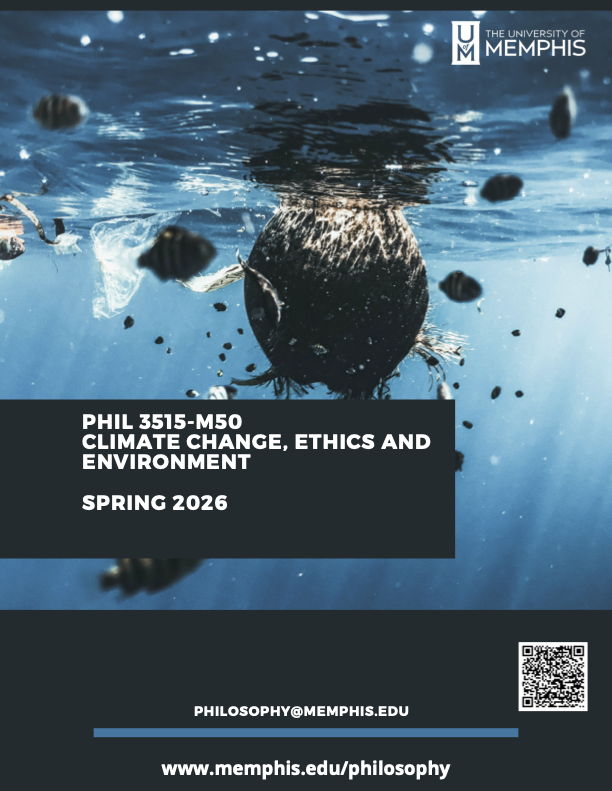
CRN 22050
Online/Asynchronous
Sara Lee
Course Description
Most agree that we should treat people with respect and concern. In other words, we
should treat people ethically. But why should this ethical treatment extend to non-human
features of our world like oceans, forests, and non-human animals? This course will
investigate the sources of our ethical commitments to the environment with a special
focus on the effects of climate change and our obligations to reduce global warming.
Attention will also be paid to distinct ethical problems like those concerning animals,
biodiversity, sustainable energy, and environmental racism.
PHIL 3621 - Formal Logic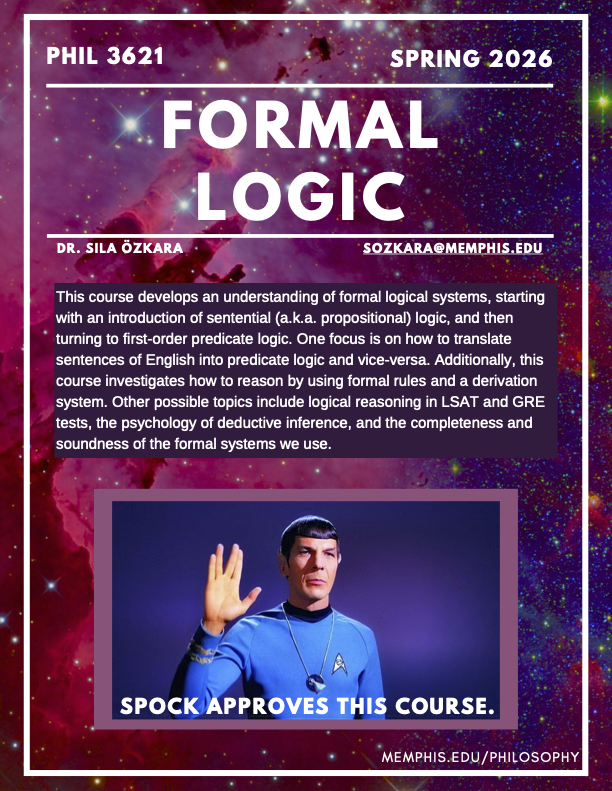
CRN
MW
2:20 - 3:45pm
Sıla Özkara
Course Description
This course develops an understanding of formal logical systems, starting with an
introduction of sentential (a.k.a. propositional) logic, and then turning to first-order
predicate logic. One focus is on how to translate sentences of English into predicate
logic and vice-versa. Additionally, this course investigates how to reason by using
formal rules and a derivation system. Other possible topics include logical reasoning
in LSAT and GRE tests, the psychology of deductive inference, and the completeness
and soundness of the formal systems we use. While there are no prerequisites for this
course, some training in, or familiarity with the use of formal reasoning as taught
in elementary logic, computer science, or mathematics has proven helpful to students.
PHIL 4801/6801 – Special Topics in Philosophy:Buddhism and Ecology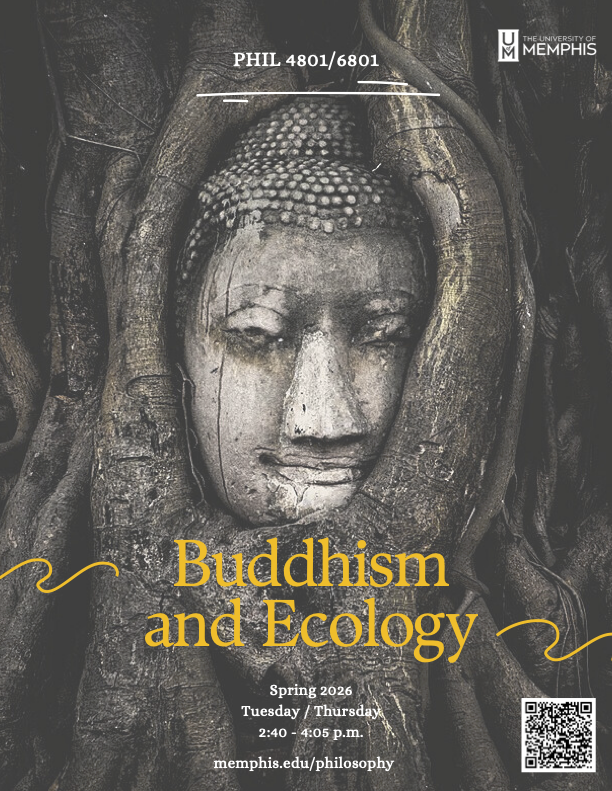
CRN
TR
2:40 - 4:05pm
Kevin Taylor
Course Description
This seminar explores the intersections of Buddhist thought and ecological philosophy,
with particular attention to metaphysics, epistemology, cosmology, and ethics. Drawing
on canonical Buddhist sources, classical East Asian commentaries, and contemporary
scholarship, the course examines how Buddhist ideas of interdependence, impermanence,
and compassion shape understandings of the natural world and inform ecological practice.
PHIL 7030/8030 - Seminar in Continental Philosophy
CRN
Thursday
5:30 - 8:30pm
Kas Saghafi
PHIL 7030/8030 - Social/Political Philosophy
CRN 18167/18168
Wednesday
2:30-5:30pm
Michael Monahan
PHIL 7514/8514 - Cognitive Science Seminar
CRN 21695/21696
Thursday
2:20-5:20pm
TBA
PHIL 7301/8301- Seminar in Modern Philosophy
CRN 18995/18996
Monday
2:30-5:30pm
Jameliah Shorter-Bourhanou
PHIL 7414/8414 - Seminar in Metaphysics
CRN 12127/12136
Tuesday
5:30-8:30pm
James Bahoh