
Experiential Learning Program - 2025 Spring Details
 Purpose
The purpose of the Experiential Learning Program is to strengthen the Public Health workforce pipeline by preparing high school students to pursue careers in Public Health after post-secondary school graduation.
 Program Goals
PUBH 3150: Health Data Analytics & Informatics
This course provides a comprehensive introduction to the origins, flow, management, and analysis of health data. It emphasizes interpreting and presenting empirical evidence within the context of public health. Students explore data-driven approaches to evaluating health programs and policies, gaining foundational knowledge in epidemiology, biostatistics, and health informatics. By the end of the course, participants are equipped with essential analytical tools to effectively interpret, apply, and communicate health data in real-world settings.
PUBH 3160: Public Health in Action
This integrative course enables students to apply research methods, experiential learning, and public health practice to address real-world public health issues. Through collaborative projects, students synthesize knowledge and competencies from this and other PUBH courses to develop practical, evidence-based solutions. The course emphasizes critical thinking, interdisciplinary collaboration, and the application of public health principles in diverse settings.
PUBH 3170: Global Health Crises & Milestones
This course introduces students to major milestones and crises in global public health. It examines both achievements and challenges that have shaped health outcomes worldwide. By the end of the course, students develop a critical understanding of global health history and its relevance in today’s interconnected world.
Special Project Workshop: Global Health Short Film
In this hands-on workshop, students work in small groups to create a short film that incorporates a comprehensive presentation of relevant public health data. The project encourages creativity, collaboration, and the effective communication of complex health issues through visual storytelling.
Computer Programming
This course offers an overview of computer science fundamentals, with a focus on problem-solving and core programming skills. Topics include primitive data types, control structures, arrays, strings, input/output operations, basic recursion, and essential techniques for documentation, testing, and debugging. Students are also introduced to foundational concepts in object-oriented programming.
ACT Prep Workshop
This dynamic and engaging workshop prepares high school students for success on the ACT (American College Testing) exam. Through interactive instruction and targeted practice, students develop the academic and test-taking skills necessary to improve their performance. The workshop builds confidence and mastery across key content areas, supporting students in reaching their college admissions goals.
 Program Objectives
By the end of the course, students were able to:
PUBH 3150: Health Data Analytics & Informatics
- Understand the fundamentals of health data management and analysis
- Apply data-driven approaches to public health decision-making
- Explain public health surveillance systems and measures of disease occurrence
- Analyze disease outbreaks using epidemiologic principles
- Differentiate between descriptive and analytic epidemiologic study designs
- Identify and describe key features of common descriptive study designs
- Understand core statistical concepts, including probability, random sampling, and statistical distributions
- Perform basic biostatistical analyses, including one-sample and two-sample hypothesis tests
PUBH 3160: Public Health in Action
- Integrated insights from individual and group assignments with scholarly research to reflect on key public health topics
- Assessed academic and non-academic resources for investigating public health problems
- Critically evaluated and synthesized scientific information related to specific public health issues
- Developed focused lines of inquiry based on how public health agencies or researchers addressed those issues
- Engaged with professionals in the field—including researchers, public health leaders, policymakers, media, and healthcare personnel—to deepen their understanding
- Evaluated and integrated collected information to propose informed, evidence-based recommendations for addressing critical public health challenges
PUBH 3170: Global Health Crises & Milestones
- Describe major global health crises and milestones that have shaped public health worldwide
- Understand the interconnected nature of global health and how health outcomes are influenced across borders
- Think critically about global health challenges and evaluate the effectiveness of international health initiatives
- Identify key strategies used to address global health crises and assess the role of global health institutions in improving health outcomes globally
Special Project Workshop: Global Health Short Film
- Develop and apply technical skills in camera operation, audio recording, and lighting to support effective filmmaking
- Collaborate on set and contribute to the production process in a team environment
- Demonstrate creative and professional proficiency in initiating, producing, and distributing video projects
- Refine storytelling and communication skills through the creation of a public health short film for the PUBH 3160 dual enrollment course
Computer Programming
- Read and write code using variables, assignments, conditionals, and loops
- Manipulate strings, lists (including one- and two-dimensional), and dictionaries
- Define and call functions with various input and output types
- Decompose programs into modular sections using functions
- Define simple classes and create objects
- Invoke methods and apply object-oriented programming principles in basic applications
 Student Outputs
The Student Outputs across the public health curriculum demonstrated students’ engagement with analytical, practical, and creative learning experiences. In PUBH 3150: Health Data, Analytics & Informatics, students completed nine weekly homework assignments, three exams, and a final project. In PUBH 3160: Public Health in Action, they wrote a 5-page background paper, conducted an interview with a health professional, submitted a 2-page reflection paper, and delivered a 10-minute presentation. For PUBH 3170: Global Health Crises & Milestones, students produced three short response papers, a 5–10-page final paper, and a 15-minute presentation with a Q&A session. The Computer Programming course focused on developing technical skills through weekly coding exercises and a final project. Additionally, in the Special Project Workshop: Global Health Short Film, student groups created 3–5 minute interview-style documentaries based on research topics from the Public Health in Action dual enrollment course.
 Program Session Dates/Times
| Session | Dates and Times |
| ACT Prep Session Dates |
|
| Virtual Session |
|
| Weekend In-Person Sessions |
Saturdays from 9am - 5pm |
 Weekly Homework
Weekly assigned homework was a consistent requirement, encompassing tasks from the PUBH dual enrollment course. Students were expected to participate in weekly virtual homework sessions to collaboratively address any questions. These sessions were mandatory to ensure that each student diligently worked towards completing all three dual enrollment courses to earn college credit.
In addition to the virtual sessions, various resources were available to support students, including access to online libraries, study guides, and tutoring services. Instructors were also available to answer any questions, and students were encouraged to contact them via call, text, or email.
 Instructors
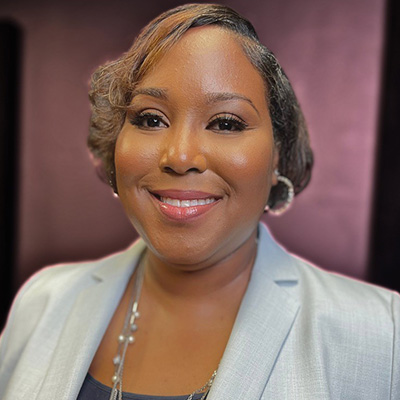
Dr. Fedoria Rugless
Research Assistant Professor, School of Health Studies
Dr. Fedoria Rugless is a Research Assistant Professor at the School of Health Studies and serves as the Director of Research for Church Health. Before joining the University of Memphis, her research interests encompassed exposure effects and neuromotor performance, patient-centered outcomes, HIV surveillance, and cancer research. She has presented her findings in various publications and at numerous conferences both nationally and internationally. Dr. Rugless is passionate about education and has served as an adjunct faculty member at several institutions within the region. She is also a Certified Clinical Research Professional through the Society of Clinical Research Associates. She is very enthusiastic about this role, as it embodies both of her passions and areas of service in the healthcare and research arenas. This dual position was developed from the President’s office in collaboration with Church Health leadership, aiming to create a nationally recognized collaborative research program between the University of Memphis and Church Health. In this role, Dr. Rugless serves as a liaison between University of Memphis investigators and Church Health to establish a robust collaborative research network that enhances the community-based clinical work being done at Church Health, while also providing University faculty with the opportunity to conduct research within a model healthcare organization. Dr. Rugless is very enthusiastic about this role as it embodies both her passions and areas of service in the healthcare and research fields. Ultimately, she aims to reduce healthcare disparities among underserved populations and ensure that all individuals achieve holistic health and wellness.
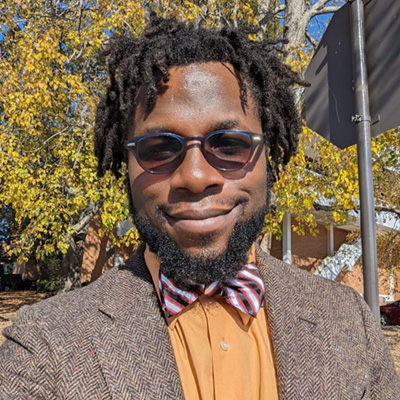
Broderick Stigall
Assistant Professor of Teaching, Computer Science
Mr. Stigall joined the Computer Science Department in Spring 2024. Prior to joining, he completed his Master of Science in Computer Science at the Georgia Institute of Technology. He also worked for ten years as a software engineer on E-Commerce teams at International Paper and AutoZone. Mr. Stigall’s research interests include voice user interfaces, speech technologies, human-computer interaction, and computer science education. At the University of Memphis, Mr. Stigall teaches undergraduate computer science courses.

Cicely Odom
Tutor Memphis901
Cicely Odom is a native Memphian and Memphis City School Alum, attending the city’s first charter school. After high school, Cicely continued her studies at LeMoyne-Owen College and University of Memphis. Having a natural love of mathematics and science, Ms. Odom attended Southwest Tennessee Community College and obtained several certifications in Mechanical Engineering and CAD. Southwest was so impressed with her achievements, they brought her aboard as an Academic Advisor and an Upward Bound math instructor. After several years working in secondary education, Cicely saw a great need to assist students prior to reaching the college level and decided to create Tutor Memphis. Tutor Memphis was born out of a need to prepare middle and high school students for standardized test to ensure every possible advantage to reaching their full potential. Ms. Odom is a dedicated and experienced tutor and mentor to many of the top students in the Memphis and surrounding areas. Specializing in making complex concepts understandable and engaging is her superpower. Her patient and personalized approach ensures that each student’s unique learning style is catered to. Ms. Odom recently obtained her Master’s in Curriculum and Instruction with goals to create a customized math curriculum that will meet the needs of underserved students in math and science. In her spare time, Cicely enjoys traveling, spending time with her family and giving back to her community.
 Graduate Assistants

Elizabeth Butler
Graduate Assistant, School of Public Health

Matthew Horton
Graduate Assistant, School of Public Health
 Photo Gallery

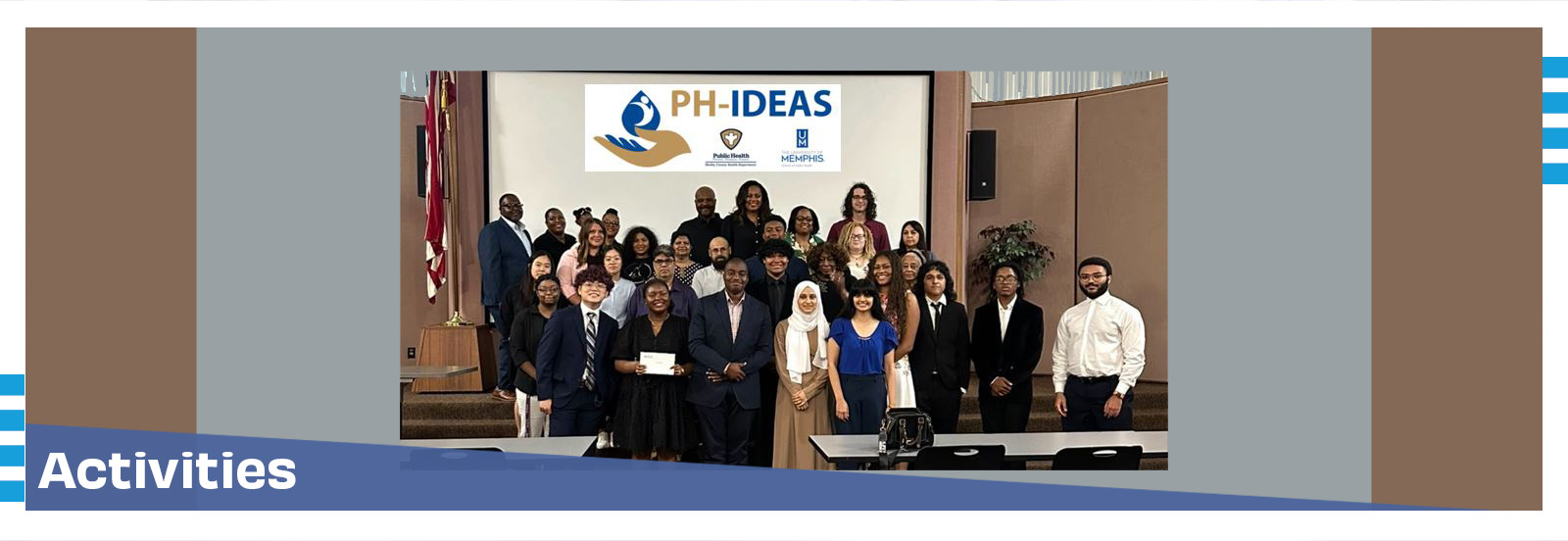
2025 Spring - Experiential Learning Program Activity - Group photo

2025 Spring - Experiential Learning Program Activity - Group photo

2025 Spring - Experiential Learning Program Activity - Student presentation

2025 Spring - Experiential Learning Program Activity - Student presentation

2025 Spring - Experiential Learning Program Activity - Student presentation

2025 Spring - Experiential Learning Program Activity - Student presentation

2025 Spring - Experiential Learning Program Activity - Student presentation

2025 Spring - Experiential Learning Program Activity - Student presentation

2025 Spring - Experiential Learning Program Activity - Student presentation

2025 Spring - Experiential Learning Program Activity - Student presentation

2025 Spring - Experiential Learning Program Activity - Student presentation

2025 Spring - Experiential Learning Program Activity - Student presentation

2025 Spring - Experiential Learning Program Activity - Group photo

2025 Spring - Experiential Learning Program Activity - Group photo

2025 Spring - Experiential Learning Program Activity - Group photo

2025 Spring - Experiential Learning Program Activity - Group photo

2025 Spring - Experiential Learning Program Activity - Group photo

2025 Spring - Experiential Learning Program Activity - Group photo

2025 Spring - Experiential Learning Program Activity - Group photo

2025 Spring - Experiential Learning Program Activity - Group photo

2025 Spring - Experiential Learning Program Activity - Group photo

2025 Spring - Experiential Learning Program Activity - At the World Federation of United Nations (WIMUN) New York Conference

2025 Spring - Experiential Learning Program Activity - At the World Federation of United Nations (WIMUN) New York Conference

2025 Spring - Experiential Learning Program Activity - At the World Federation of United Nations (WIMUN) New York Conference

2025 Spring - Experiential Learning Program Activity - At the World Federation of United Nations (WIMUN) New York Conference

2025 Spring - Experiential Learning Program Activity - Flyer - Closing Ceremony of CDC Workforce Pipeline Experiential Learning Program