
NSF Fellowship Award and Honorable Mention
Two UofM students were recognized by the NSF for their outstanding contributions to scientific research
Alexandra Snyder has received a National Science Foundation (NSF) Graduate Research Fellowship centered
on her own experience with and research focused on hypermobile Ehlers-Danlos Syndrome
(hEDS). Alexandra’s personal experience with hEDS led her to utilize her love of medicine
to make a difference in the hEDS community. She met Dr. Gary Bowlin, Chair of Excellence
and Professor of Biomedical Engineering at the University of Memphis, in the fall
of 2022 and realized that her dream of studying hEDS was not out of reach.
Alexandra’s research focuses on the use of Manuka honey to reduce inflammation mediated
by neutrophils. She is currently exploring the use of Manuka honey and Manuka honey
incorporated near-field electrospun (NFES) bioresorbable tissue templates as a drug
delivery system using polydioxanone (PDO), a biodegradable synthetic polymer that
degrades over a 6-8 month period, aligning with the duration of wound healing. Manuka
honey has been used to treat chronic wounds in patients with classical type EDS. Her
innovative work is an example of translational science that has the potential to significantly
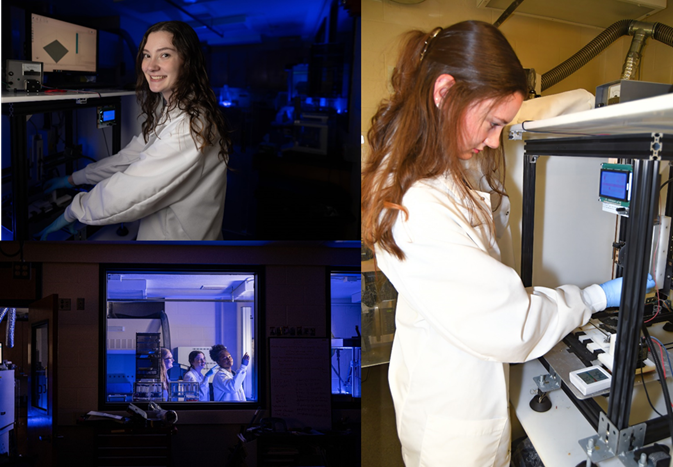
impact on human health and addres the burdens of EDS. The pictures below show Alexandra
performing research in her lab and setting up the apparatus to fabricate the Manuka
honey incorporated NFES tissue templates that she is developing.
Rebecca Davis has received a honorable mention designation for the NSF Graduate Research Fellowship
Program (GRFP). Rebecca performs research under the guidance of Matthew Parris, Associate
Professor of Biological Sciences at the University of Memphis, as well as in collaboration
with the Memphis Zoo’s Department of Conservation and Research. Her research centers
on ethical approaches to the conservation of endangered Louisiana pine snakes with
a focus on temperature influences on pine snake reproductive cycles. Her research
on reproduction of this endangered species is concentrated on brumation - a period
of overwinter dormancy that many reptiles undergo annually, yet its physiological
and fitness consequences remain poorly understood. As reptiles are ectothermic (i.e.,
cold-blooded), their physiology is heavily dependent upon environmental cues, one
of the most important of which is temperature. Her pioneering of minimally invasive
techniques will generate fundamental discoveries on the physiological impacts of a
changing climate not only for this endangered species, but reptiles more broadly.
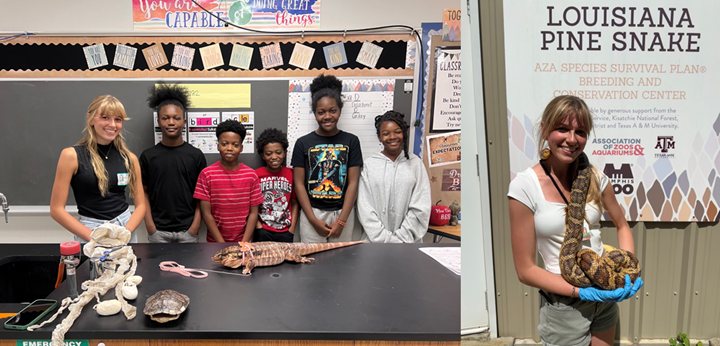
In addition to her research, Rebecca also participates in a number of educational
outreach programs. She has a pet Tegu lizard named Tami (picture below) that she brings
along to teach youth about herpetology (the scientific / zoological study of reptiles
and amphibians).
The University of Memphis is proud to highlight these outstanding students and their
impactful research.
If you have any questions about the NSF GRFP program or the research being carried
out by our students, reach out to the University of Memphis’s NSF GRFP coordinator, Dr. Brian Evans, at bevans8@memphis.edu.